By the nineteenth century, analysis had learned to speak in limits, but the real line itself still needed a precise construction. The arithmetization of analysis means this: geometry and motion should rest on arithmetic objects whose properties can be proved from clear definitions.
Dedekind cuts
Definition. A Dedekind cut is a nonempty proper subset \(A\subset\mathbb Q\) that is downward closed and has no greatest element. Intuitively, it records all rational numbers lying to the left of a real point.
The cut for \(\sqrt2\) is the set of rationals \(q\) with \(q<0\) or \(q^2<2\). The point \(\sqrt2\) is not inserted from geometry; it is reconstructed as a pattern in \(\mathbb Q\).
Completeness becomes a theorem
Theorem. The set of Dedekind cuts, with the natural order and arithmetic operations, is a complete ordered field.
Proof sketch. The least upper bound of a nonempty bounded family of cuts is given by the union of those cuts. This union is again a cut, and it is the smallest cut containing every member of the family. Arithmetic is defined by rational representatives and then checked to be compatible with the cut axioms.
Cantor's sequences and infinities
Cantor approached the continuum through Cauchy sequences and then discovered that infinite sets have different sizes. The diagonal argument proves that \(\mathbb R\) is uncountable, so the continuum is not merely a long list of rational approximations.
Proposition. No enumeration \(x_1,x_2,\ldots\) lists all real numbers in \((0,1)\). The diagonal construction builds a real number differing from \(x_n\) in its \(n\)-th decimal place.
What changed
Analysis became less dependent on diagrams and more dependent on structures: ordered fields, completeness, sequences, sets, and maps. This did not make geometry irrelevant; it gave geometry a precise arithmetic skeleton.
Two constructions, one demand
Dedekind cuts and Cauchy-sequence constructions look different, but they answer the same demand: every legitimate limiting process should have a place to land. Cuts emphasize order and least upper bounds; sequences emphasize convergence and approximation. Modern analysis freely moves between these faces of completeness.
This is also where the continuum stops being a passive picture and becomes a theorem-bearing object. Intermediate value, compactness of closed intervals, convergence of monotone bounded sequences, and the Heine-Borel theorem all depend on completeness, not merely on the density of rational numbers.
The construction of the continuum
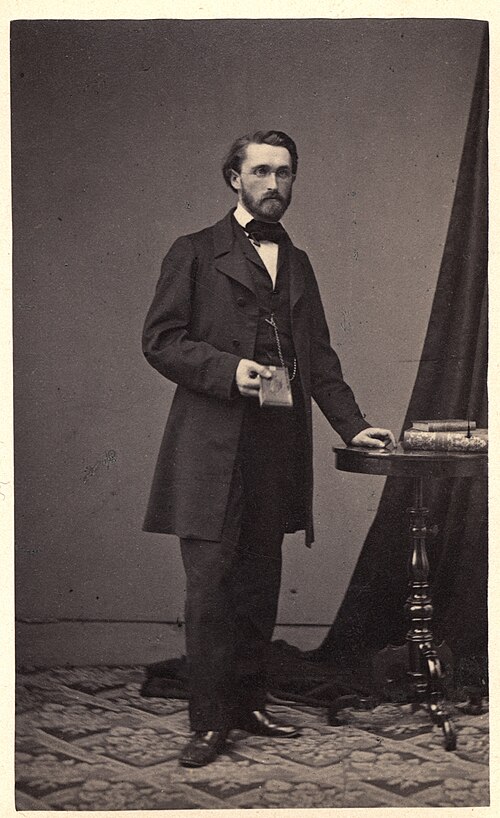
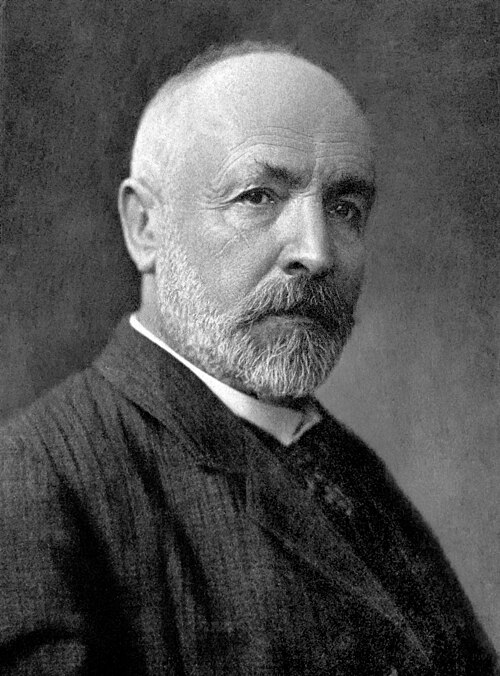
Weierstrass demanded rigor in limits; Dedekind defined real numbers by cuts; Cantor created set theory and the arithmetic of infinity; Méray and Heine also contributed sequential constructions of the continuum.
1872: several constructions of the same continuum
In 1872, Dedekind published his construction by cuts and Cantor developed real numbers from fundamental sequences. Their objects look different: a Dedekind real is a partition of \(\mathbb Q\), while a Cantor real is an equivalence class of rational Cauchy sequences. The crucial achievement was not choosing between them, but proving that both realize the same complete ordered field.
Dedekind cut. A cut is a proper, nonempty lower set \(A\subset\mathbb Q\) with no greatest element: \[ x\in A,\ y<x\Longrightarrow y\in A. \] The rational \(r\) gives \(A_r=\{q:q<r\}\); a cut such as \[ \{q:q<0\text{ or }q^2<2\} \] fills the gap corresponding to \(\sqrt2\).
Theorem. The ordered field of Dedekind cuts has the least-upper-bound property.
Proof. If a nonempty family \(\mathcal A\) of cuts is bounded above, set \[ S=\bigcup_{A\in\mathcal A}A. \] The union is nonempty, proper because of the upper bound, downward closed, and has no greatest element. Thus \(S\) is a cut. It contains every \(A\in\mathcal A\), and any upper bound contains their union, so \(S\) is their least upper bound.
Cantor separates size from enumeration
Cantor's diagonal argument proved that no list can contain every infinite binary sequence. Given a proposed list \((x_{n1},x_{n2},\ldots)\), the sequence \[ y_n=1-x_{nn} \] differs from row \(n\) at its \(n\)-th coordinate. This did more than exhibit a large set: it showed that infinity has distinct cardinalities.
Dedekind's work emphasized continuity and the structural characterization of number systems; Cantor's emphasized sets, order types, and transfinite arithmetic. Together they shifted analysis away from geometric intuition as its final court of appeal. Arithmetic itself had become capable of building the line.
Completeness rather than construction
Modern analysis usually takes \(\mathbb R\) to be a complete ordered field and invokes a uniqueness theorem: any two complete ordered fields are uniquely isomorphic after fixing \(\mathbb Q\). The historical constructions remain valuable because they prove existence and show exactly which gaps completion repairs.