Cantor opened a new universe: sets could be counted, compared, and organized even when infinite. But the first language of sets was too generous. If every property defines a set, then some properties define contradictions.
Naive comprehension
Definition. Naive comprehension is the principle that for every property \(P(x)\) there is a set \(\{x:P(x)\}\) consisting exactly of the objects satisfying it.
This principle expresses a natural habit of thought: collect all objects with a feature. The paradoxes show that unrestricted collecting is not innocent.
Russell's paradox
Theorem. Unrestricted comprehension is inconsistent.
Proof. Let \(R=\{x:x\notin x\}\). If \(R\in R\), then by definition \(R\notin R\). If \(R\notin R\), then by definition \(R\in R\). Both alternatives contradict themselves.
Other warnings
Russell's paradox was not alone. Burali-Forti's paradox involved the class of all ordinals; Cantor's paradox involved the class of all sets and the power-set theorem. Each warning pointed to the same moral: the universe of sets cannot itself be handled as an ordinary set.
Repair by restriction
Proposition. Restricted separation avoids Russell's contradiction: from an already given set \(A\), one may form \(\{x\in A:P(x)\}\), but one may not form the set of all objects satisfying \(P\).
The crisis did not reject sets. It made set theory more disciplined. Modern axioms preserve Cantor's productive ideas while blocking self-referential totalities from becoming sets.
Paradox as diagnosis
The paradoxes were not mere puzzles; they diagnosed a hidden assumption that every meaningful condition names a completed object. Once this assumption was exposed, mathematicians could separate language from existence: a formula may be meaningful without determining a set.
Different repairs emphasize different lessons. Type theory blocks self-reference by sorting objects into levels; Zermelo-Fraenkel set theory blocks unrestricted totalities by axiomatizing allowed constructions; category-theoretic foundations later shift attention from membership to maps and universal properties.
Paradox and axiomatic repair
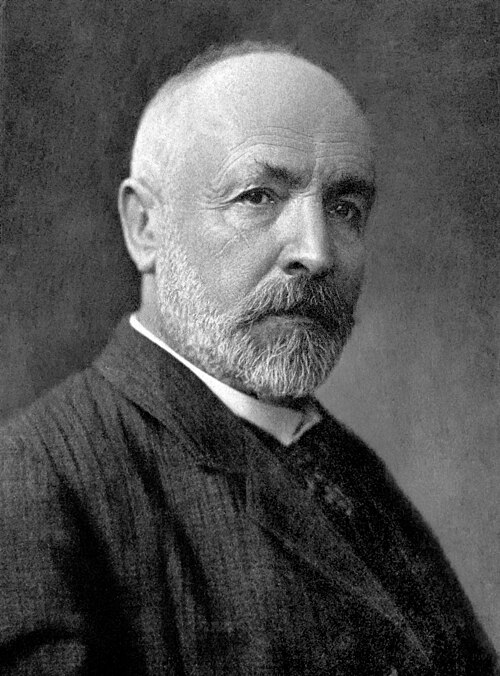
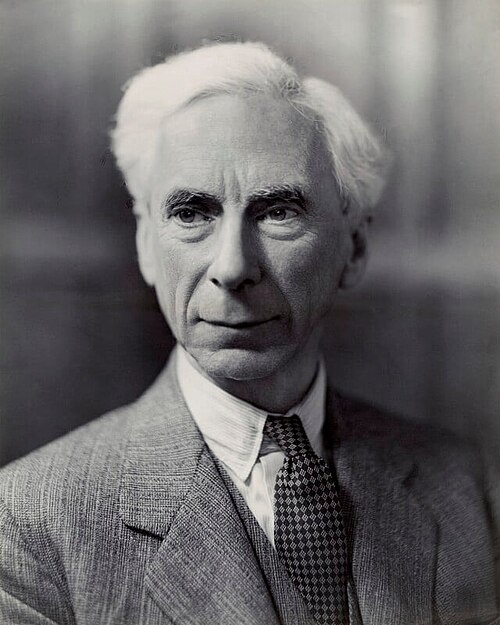
Cantor created the paradise of sets; Frege tried to ground arithmetic in logic and was struck by Russell's letter; Russell isolated the paradox; Cesare Burali-Forti's work on ordinals exposed another fracture; Zermelo began the axiomatic repair.
Frege receives Russell's letter
In June 1902, as the second volume of Frege's Grundgesetze der Arithmetik was going to press, Russell informed him that the unrestricted formation of extensions led to contradiction. Frege added an appendix acknowledging that the foundation of his system had been shaken. The episode is striking because the paradox did not arise at the untidy edge of mathematics; it appeared inside an exceptionally ambitious attempt at logical precision.
Russell's set \[ R=\{x:x\notin x\} \] compresses the problem to one self-referential question. Cantor's paradox uses the power-set theorem: \[ |\mathcal P(X)|>|X| \] for every set \(X\). If a universal set \(V\) existed, then \(\mathcal P(V)\subseteq V\) and could not be strictly larger. Burali-Forti's paradox similarly shows that the collection of all ordinals cannot itself be an ordinal.
Three diagnoses of the same wound
The repairs did not all interpret the error identically. Russell's type theory prohibited an expression from applying to itself by stratifying logical levels. Zermelo's axioms permitted subsets to be separated only from an already existing set. Later von Neumann-Bernays-G?del theory distinguished sets from proper classes, allowing talk about all sets without treating that totality as a member-bearing set.
The durable methodological lesson is that grammar does not guarantee ontology. A formula \(P(x)\) may be meaningful without there being a set of all \(x\) satisfying it. Axioms specify which constructions exist; logic alone does not silently create their outputs.