Cantor discovered that \(\mathbb N\) and \(\mathbb R\) have different sizes. The continuum problem asks whether there is a size strictly between countable infinity and the size of the real line. It became Hilbert's first problem and later a model case for independence.
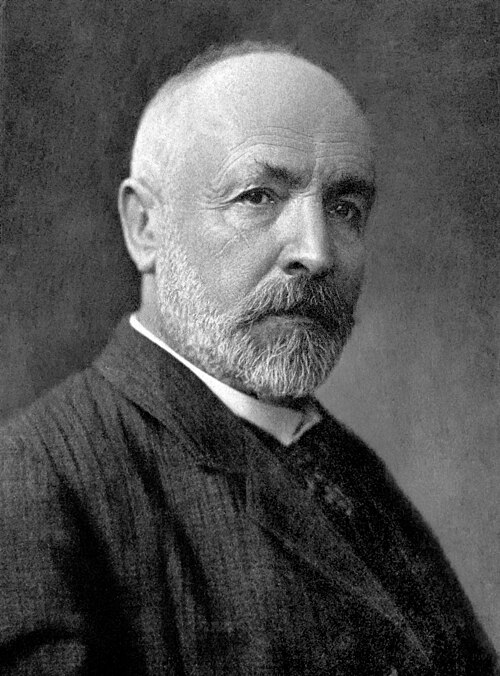
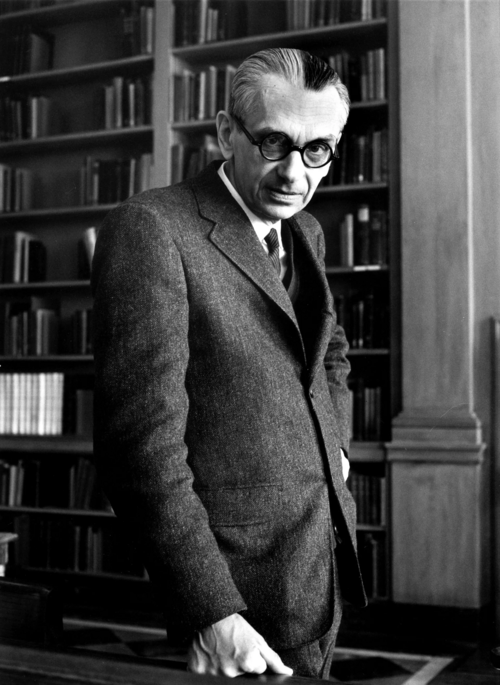
Continuum hypothesis
Definition. The continuum hypothesis states that every infinite subset of \(\mathbb R\) is either countable or has the same cardinality as \(\mathbb R\). Equivalently, \(2^{\aleph_0}=\aleph_1\).
Gödel's constructible universe
Gödel constructed the inner model \(L\), the universe of constructible sets. Inside \(L\), the axioms of ZFC hold and the continuum hypothesis holds. Therefore, if ZFC is consistent, ZFC cannot disprove CH.
Theorem. If ZF is consistent, then ZFC plus the continuum hypothesis is consistent relative to ZF.
Cohen's forcing
Paul Cohen invented forcing to build models in which new sets are added in a controlled way. He showed that CH can fail while the axioms of ZFC remain true. This completed the independence result.
Theorem. If ZFC is consistent, then ZFC plus the negation of the continuum hypothesis is also consistent.
Meaning of independence
Independence does not mean that the question is meaningless. It means that the chosen axioms do not settle it. Set theorists may then study stronger axioms, forcing axioms, large cardinals, or structural criteria for deciding which extensions of ZFC are mathematically fruitful.
Models as mathematical worlds
The independence of CH changed the meaning of foundational work. Axioms are no longer only rules for deduction; they also describe possible universes. One model can satisfy CH, another can satisfy \(\neg\mathrm{CH}\), and both can satisfy ZFC if the background consistency assumptions hold.
This made model construction a central method. Gödel's \(L\) shows how a thin, definable universe behaves; forcing shows how to extend a universe by adding generic objects. Together they teach that the set-theoretic universe has a geometry of possible extensions.
Cardinality, constructibility, and forcing
Cantor posed the continuum problem through his theory of cardinality; Hilbert placed it first on his 1900 list; Gödel proved relative consistency with CH; Cohen proved relative consistency with not-CH and introduced forcing, one of the great methods of modern logic.
From Cantor's first problem to two model universes
Cantor asked whether every infinite subset of the real line is either countable or equinumerous with \(\mathbb R\). In cardinal notation, the continuum hypothesis is \[ 2^{\aleph_0}=\aleph_1. \] Hilbert placed it first on his 1900 list, signaling that understanding the continuum had become a central test of the new set theory.
G?del's constructible universe \(L\) is built by iterating definability rather than the full power-set operation. It is an inner model of ZF and satisfies both choice and the generalized continuum hypothesis. Therefore, if ZF is consistent, it cannot refute CH.
Forcing enlarges the universe without breaking its axioms
Cohen's forcing begins with a partial order of finite approximations. A generic filter selects a coherent object not present in the original model, such as a new subset of \(\mathbb N\). Names and the forcing relation \[ p\Vdash\varphi \] allow the extension's truth to be controlled from within the ground model. By adding sufficiently many new reals while preserving cardinals, Cohen built a model of ZF in which CH fails.
Independence theorem. If ZFC is consistent, then both \[ \mathrm{ZFC}+\mathrm{CH} \quad\text{and}\quad \mathrm{ZFC}+\neg\mathrm{CH} \] are consistent.
The theorem does not say that CH has no truth value in every philosophical sense. It says that the accepted axioms do not determine one. One may seek new axioms justified by explanatory power, naturalness, or their consequences for the structure of sets.
Independence becomes a mathematical method
Forcing was soon used far beyond CH: Suslin's hypothesis, Martin's axiom, cardinal characteristics of the continuum, and combinatorial principles can vary across models. Set theory thereby acquired a distinctive mode of understanding. Instead of asking only whether a proposition follows, it maps the landscape of axioms under which the proposition changes and identifies the exact strength responsible.